Beach vs. Cenote Proposals in Riviera Maya: How to Choose Your Setting
The Caribbean beach or a candlelit cenote? An honest comparison of privacy, weather, sargassum, photography, and cost — from planners who stage proposals in both.
What couples need to know
- Choose the beach for the open Caribbean horizon, golden-hour warmth, and an easy transition into dinner or a celebration with loved ones.
- Choose a cenote for privacy, atmosphere, and a setting that could only exist in this corner of Mexico.
- Sargassum and tropical weather are real beach variables — and increasingly unpredictable ones. One beach can be pristine while another a mile away is not.
- A cave cenote is naturally sheltered, but cenotes vary: confirm exclusivity, access, and a rain plan for your specific venue.
- When couples ask what we would do, we usually start with a private cenote — then design the celebration around it.
Beach or cenote? The quick comparison
| What matters | Beach proposal | Cenote proposal |
|---|---|---|
| Feeling | Open, classic, celebratory | Intimate, cinematic, unexpected |
| Privacy | Public beaches are shared; private venues buy control | High with an exclusive booking — confirm it in writing |
| Light | Golden hour over a wide horizon | Candlelight, water, and stone; needs a photographer who knows the space |
| Weather exposure | Wind, rain, and surf can reshape the plan | Cave cenotes are sheltered; open-air cenotes still feel the rain |
| Sargassum | Seasonal, variable, and hard to predict — even beach to beach | Not a factor |
| Investment | Public beaches can be economical; private setups add cost | Exclusive access, transport, and lighting raise the baseline |
Before the ring, before the flowers, before you decide whether a saxophonist should appear at exactly the right moment, a Riviera Maya proposal begins with one question: where?
For most travelers, the answer seems obvious. This coast is on postcards for a reason — pale sand, palms, water in a blue that barely looks real. But the Riviera Maya holds a second answer that most visitors never think to ask about: the cenote. Freshwater pools carved through limestone over thousands of years, some open to the jungle sky, some hidden inside caverns where candlelight moves across stone and still water.
We plan proposals in both settings, and we love both. But they are not interchangeable, and choosing between them is less about which is “best” than about the moment you want to remember. Here is how we walk couples through the decision — including the parts of it that other guides tend to gloss over.
Start with the feeling, not the photo
A beach proposal is expansive. The horizon does half the emotional work: open sky, the sound of water, a sense of occasion that everyone recognizes instantly. It suits a partner who loves the Caribbean, a surprise reveal with family waiting nearby, or a proposal that flows straight into champagne and dinner on the sand.
A cenote proposal is the opposite gesture. Instead of opening outward, it draws inward. You descend toward cool stone and turquoise water, the light changes, and the outside world simply stops. It suits a partner who would rather cry, laugh, and catch their breath without an audience — someone for whom privacy is the luxury.
If you read those two paragraphs and one of them sounded like your partner, you may already have your answer. If not, keep going.
The beach proposal: classic for a reason
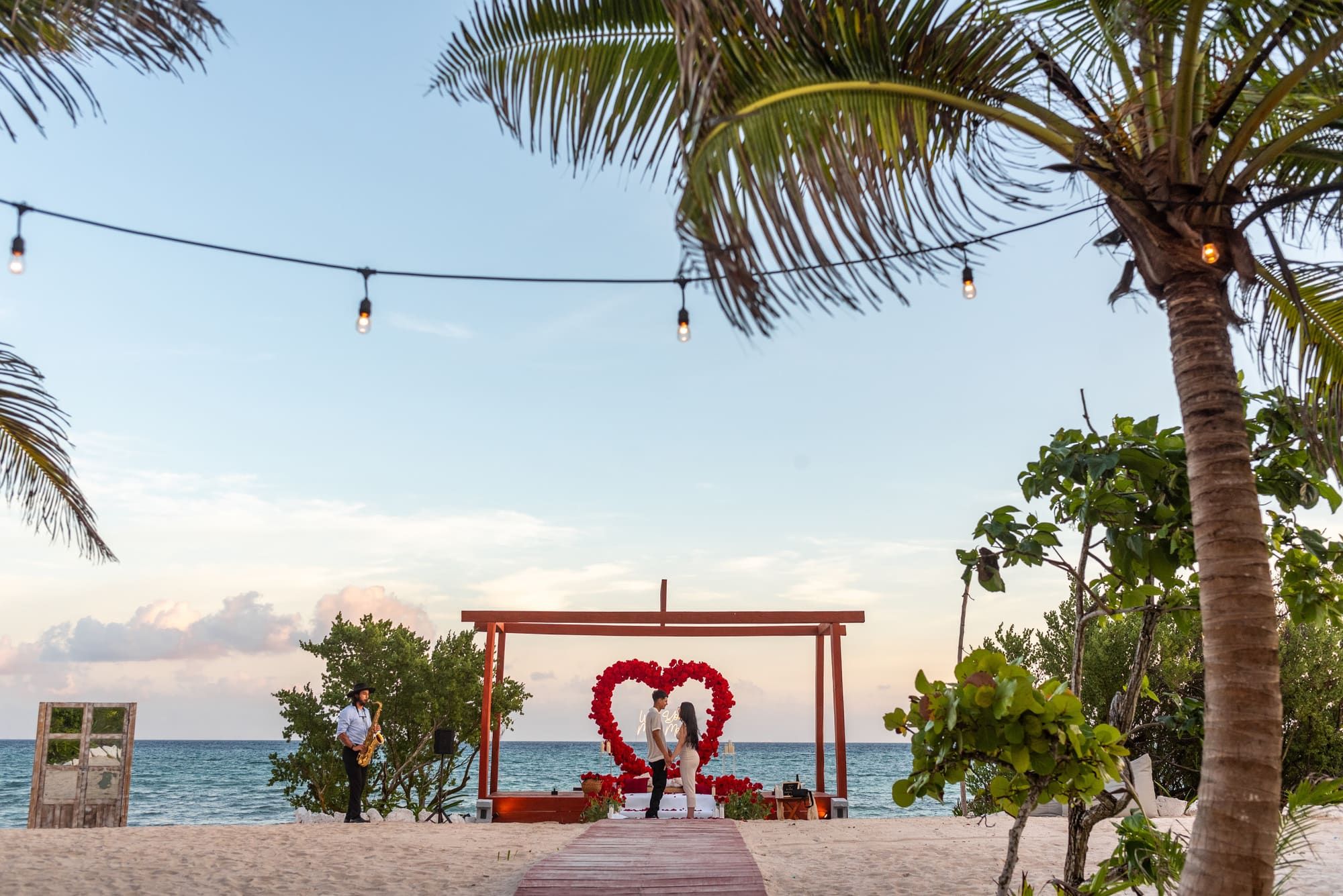
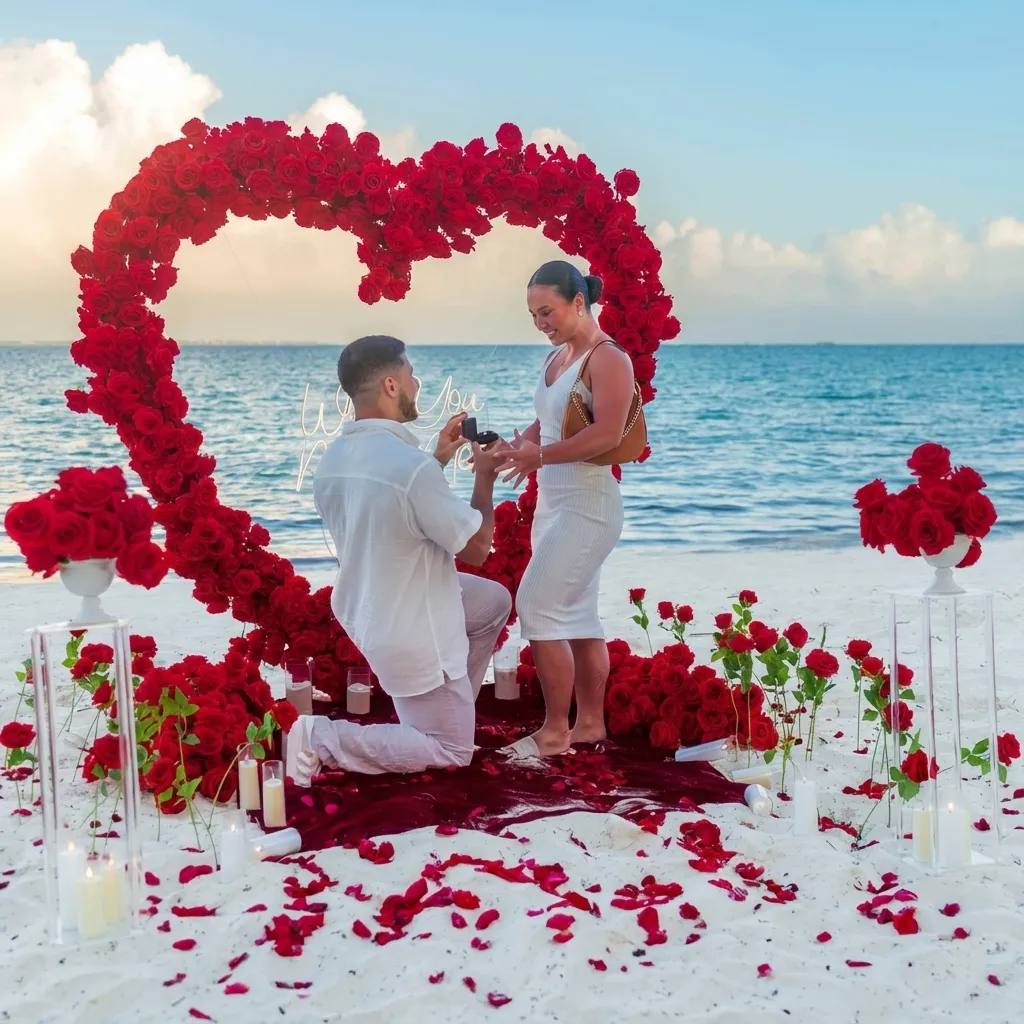
There is nothing unimaginative about choosing the icon. The Caribbean is world famous because it earns it, and a well-placed setup — an arch of roses, a path of petals, a musician a few steps away — gives all that beauty a focal point.
Beach: The appeal is immediate: open horizon, soft late light, and a setting your partner understands the second they see it.
Why couples choose the beach
- It is instantly, unmistakably romantic. No explanation required. The setting reads as celebration from the first glance.
- Golden hour is generous. The late-afternoon light here is soft and flattering. One honest note: much of this coast faces east, so on many beaches the sun sets behind you rather than into the sea. The hour before sunset is still the most beautiful light of the day — it just glows across the water instead of sinking into it.
- You have real range in venues. A public beach, a resort’s private section, or a beach club each create a different experience at a different price.
- Groups work easily. It is simple to stage friends and family nearby, keep the surprise intact, and move everyone into dinner without a second journey.
Public or private beach?
A public beach can be the more economical choice, and some are genuinely stunning. The trade-off is control: swimmers, walkers, vendors, someone else’s speaker, another proposal setup fifty meters away. Public access also does not automatically mean event setups are permitted — local rules and hotel boundaries still apply, which is one place a local planner earns their keep.
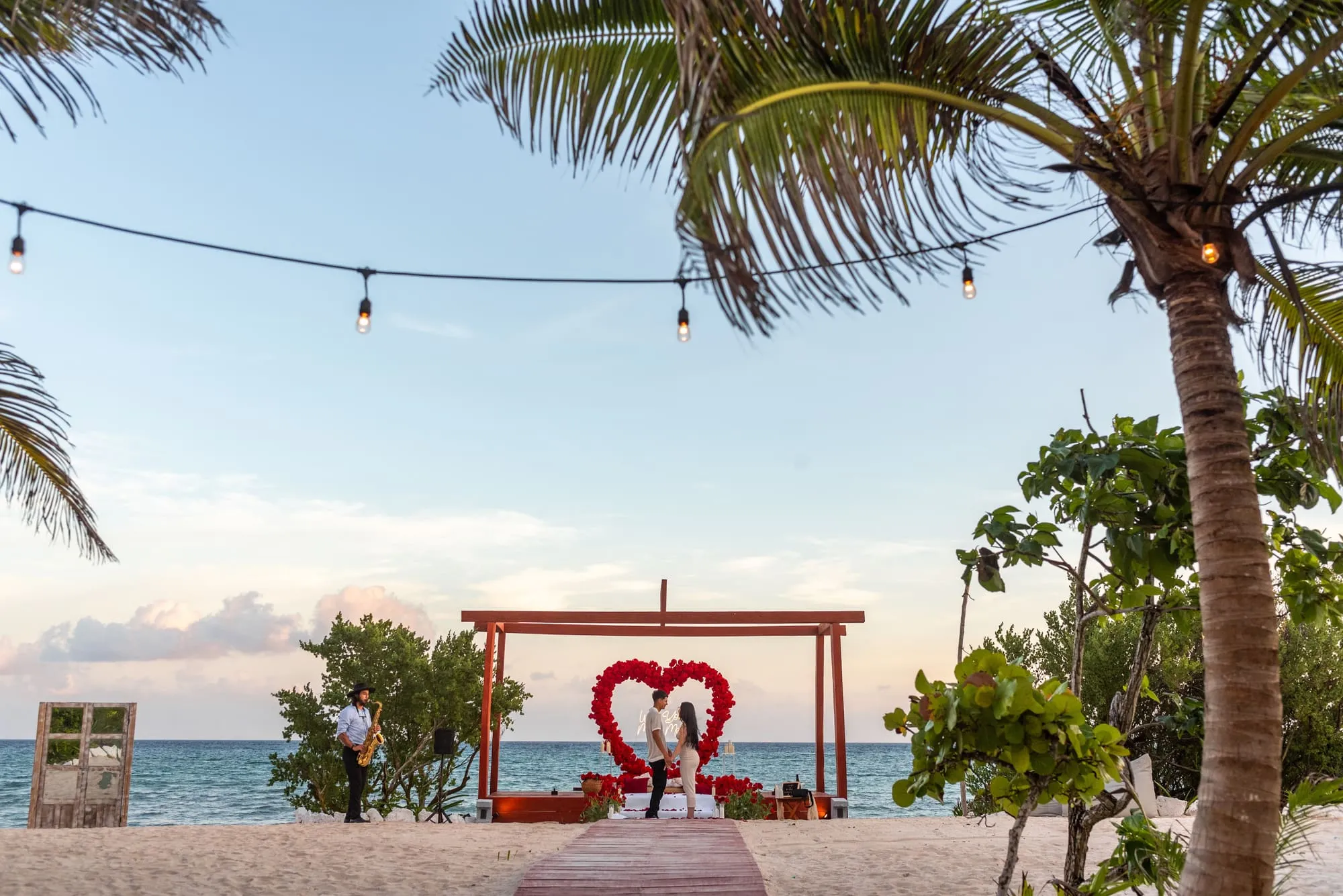
A private beach section or beach club costs more and buys you a different day: a protected surprise, a clean background for photography, room for florals and live music, and a shoreline that belongs to your moment.
Control: Private beach setups earn their value by protecting the background, the timing, and the feeling that the shoreline belongs to your moment.
What the beach asks you to plan for
The same forces that make a beach feel alive also make it changeable. Three deserve honesty:
Sargassum. The seaweed question is real, and anyone who promises you a spotless shoreline months in advance is guessing. Sargassum has traditionally been a summer phenomenon, but in recent years it has appeared as early as February, and its behavior is stubbornly local — one beach can be pristine while another a mile down the coast is blanketed. We treat it the way sailors treat weather: monitor closely near the date, and keep an alternative ready.
Tropical weather. This is the tropics; sometimes it storms. A passing shower often clears in twenty minutes, but sustained wind, rough surf, or a rainy-season downpour changes both the comfort and the look of an open-beach proposal. A beach plan should always carry a graceful backup — not a scramble.
Exposure. Even a gorgeous public beach can feel too public for the actual moment. If your partner is private by nature, no floral installation solves that. A more controlled venue does.
The cenote proposal: what we usually recommend
Here is where we show our hand. When couples ask what we would choose, we most often start with a private cenote.
Not because the beach is lesser — but because a cenote offers something a beach cannot: discovery. Your partner has seen a beautiful beach before, even if only in pictures. Almost no one is prepared for the moment they step into a candlelit cavern where limestone meets water so clear it seems lit from below. The proposal does not borrow a famous backdrop; it happens inside a world that exists, for one hour, only for the two of you.
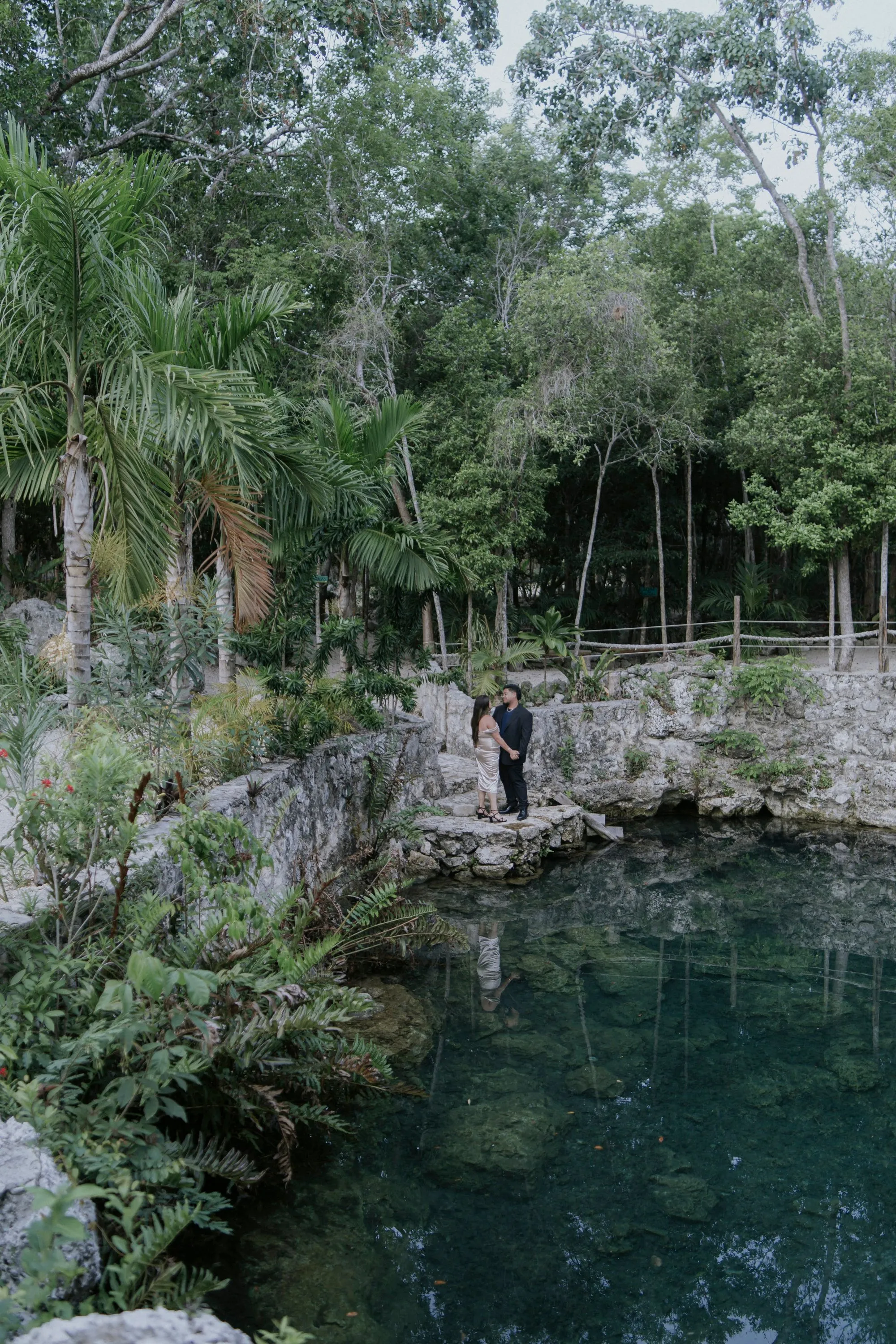
Cenote: This is the part many travelers never picture in advance. The experience begins before the proposal itself, because the location already feels discovered.
Why a cenote may be the better fit
- It feels singular. A beach is universally beautiful. A cenote is specifically, unmistakably Yucatán — ethereal in a way that photographs can only partly convey.
- Privacy is built in. Most cenote proposals are arranged around exclusive access or a reserved private window. Confirm this in writing: popular cenotes receive visitors when they are not booked exclusively.
- No sargassum. You are not negotiating with the ocean for the setting to look its best.
- Cave cenotes shrug off weather. An enclosed or mostly enclosed cenote offers real shelter, which makes it our quiet favorite for rainy-season proposals.
- The atmosphere works for you. Stone, water, candlelight, and silence create drama that would take an enormous installation to manufacture anywhere else.
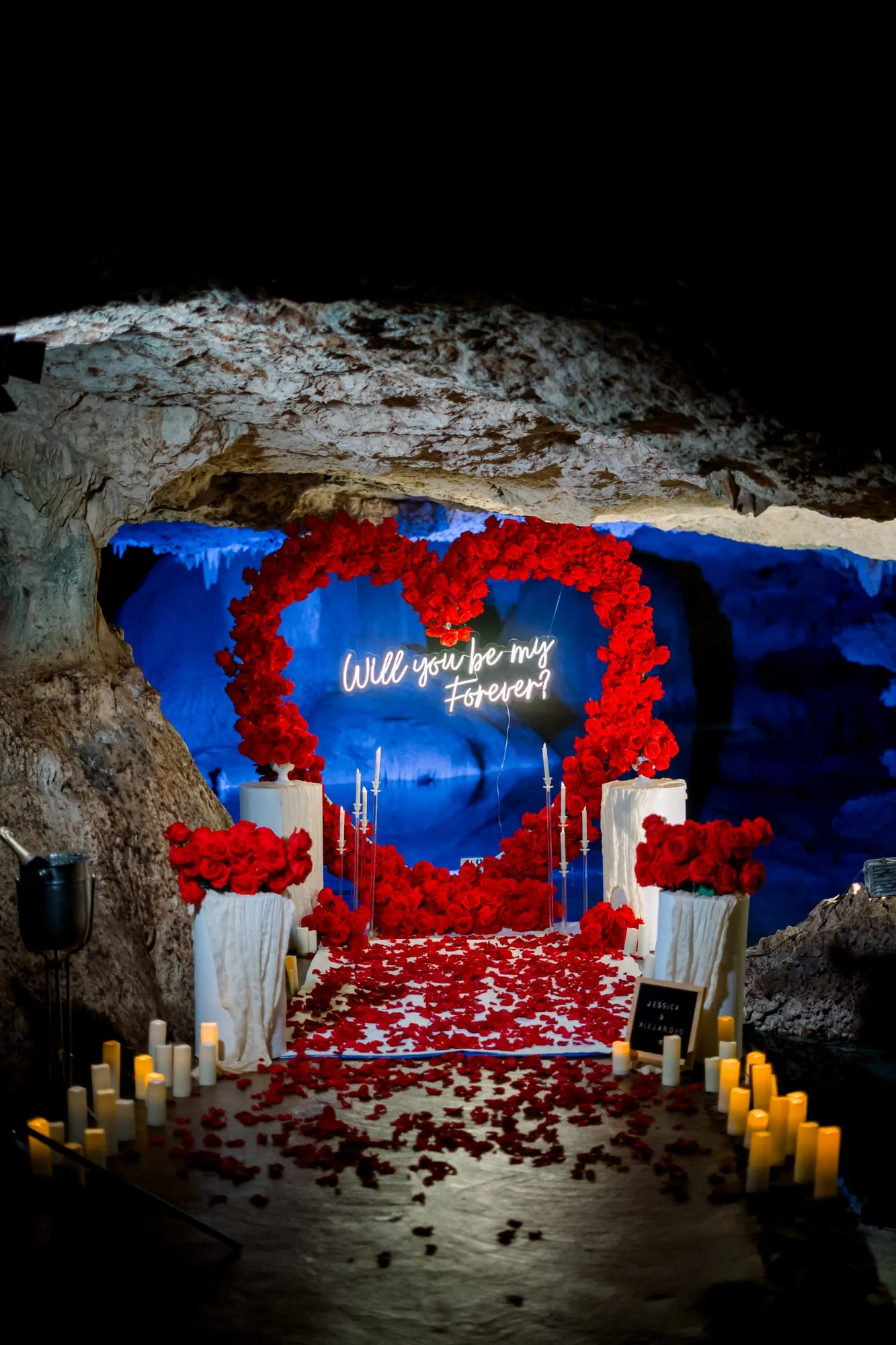
Atmosphere: In a cave cenote, the stone, reflections, and candlelight do half the staging work for you. That is why the setting feels so singular in person.
The honest trade-offs
Cenotes are not effortless — the sense of occasion comes partly from the logistics behind it.
They can cost more. Exclusive access, transport, staffing, lighting, and bringing in décor or dining all add to the investment. A public beach will often be the lighter line item; a private cenote sits closer to a private beach setup in budget.
Access takes planning. Stairs, uneven stone, wet surfaces, and the drive from your hotel all need to suit the couple — and any guests. A dramatic cavern is never worth someone feeling unsafe on the way in.
Photography demands a specialist. Cenotes are beautiful precisely because they are not evenly lit, and that is exactly what makes them hard to shoot. Dark stone, reflective water, candle flame, and the occasional shaft of daylight require a photographer with real cave experience and a lighting plan. With the right one, the images are unlike anything else in your life. With the wrong one, they are dim.
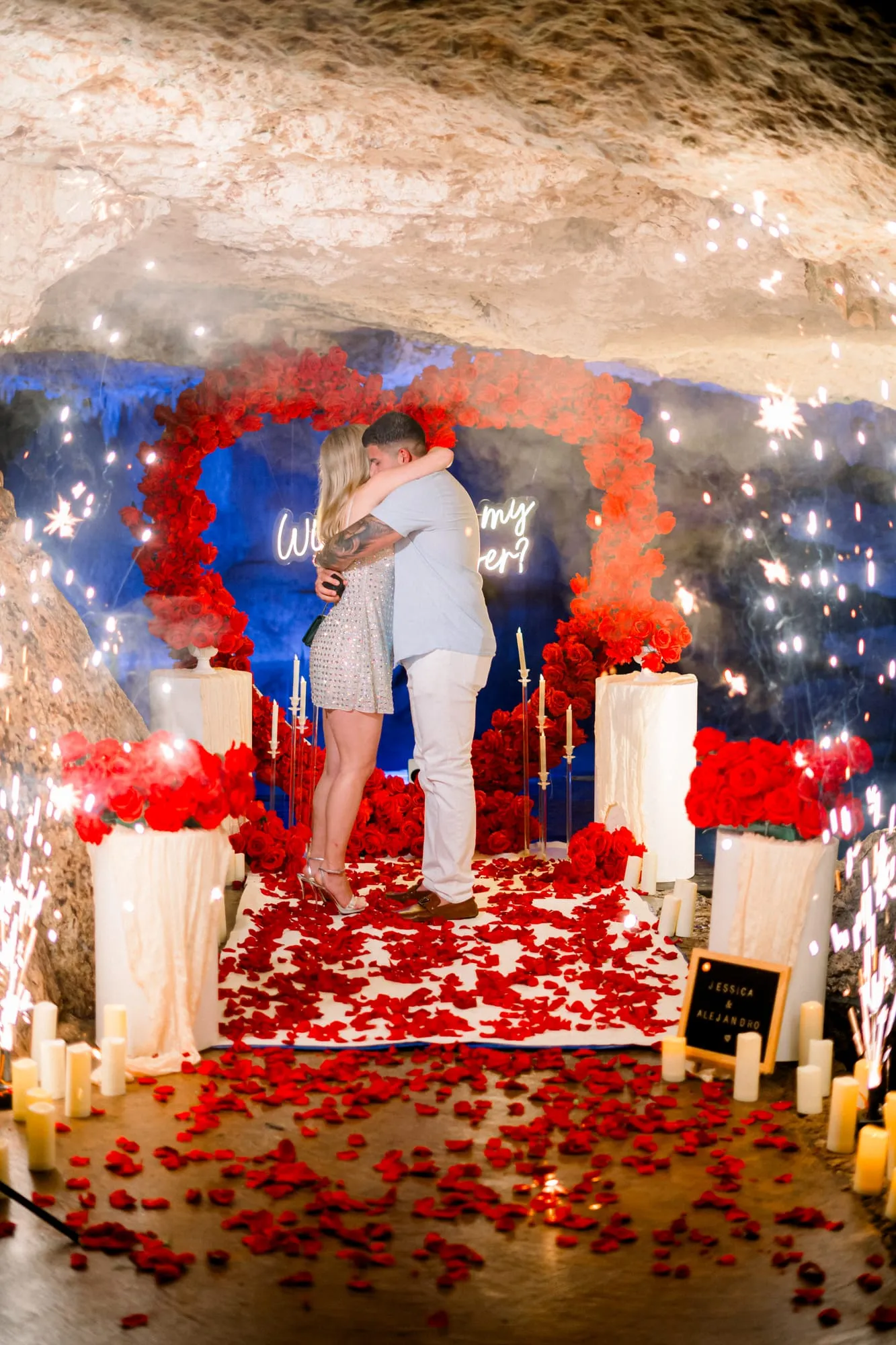
Photography: Cenote images can be extraordinary, but only when the photographer knows how to work with low light, reflective water, and cave color.
Not every cenote is weather-proof. Cave cenotes are the sheltered choice. Open-air cenotes still respond to rain, and heavy weather can affect access roads or venue operations. Choose the venue for the season, not just the photograph.
Five questions that decide it
- Would your partner rather look outward or disappear into the moment? Horizon: beach. Immersion: cenote.
- Is privacy negotiable? If not, start with a private cenote or a genuinely private beach venue — never a public beach at a busy hour.
- Are friends and family part of the surprise? Groups favor the beach. A cenote works for a small circle, or for a private proposal followed by a celebration elsewhere.
- When are you traveling? Rainy season and peak sargassum months tilt toward a cave cenote. A dry-season winter date opens the beach wide.
- Which pictures feel like the two of you? Warm, open, and coastal — or candlelit, textural, and cinematic?
You do not have to choose only one
Some of our favorite proposal days refuse the either/or entirely. The proposal happens in a private cenote — quiet, unhurried, just the two of you and the candlelight. Then the evening opens up: a Caribbean dinner, toes in the sand, family arriving with champagne. The intimate moment stays intimate; the celebration gets the horizon.
And whichever setting you choose, insist on a backup that still feels chosen. For a beach, that might be a covered terrace or a cenote already on standby. For a cenote, it means a confirmed rain protocol and access plan. The most reassuring luxury in a Riviera Maya proposal is not the flowers — it is knowing that no version of the weather can take the day from you.
Our recommendation, plainly
Choose the beach when the ocean is part of your love story — when you want that first glimpse of blue water, the golden hour, and an easy slide into a celebratory night with the people you love.
Choose a private cenote when you want the setting itself to be the surprise. It is the choice we make most often for couples who value privacy over familiarity, and it greatly reduces the coast’s most unpredictable variables while keeping a venue-specific weather and access plan in place.
The best next step is a short conversation about your partner, your dates, and the surprise you are protecting. Explore Amar’s proposal experiences or start planning with our team; we will help you find the setting that feels inevitable the moment you see it.
Questions, answered
Are cenote proposals better than beach proposals in Riviera Maya?
For many couples, yes — but not all. We recommend a private cenote most often because it offers privacy and a setting that feels genuinely rare. The beach remains the better choice for couples who want the classic Caribbean scene, a group reveal, or a seamless move into dinner by the water.
Is sargassum a problem for a Riviera Maya beach proposal?
It can be. Sargassum has traditionally been a summer issue, but in recent years it has arrived as early as February, and it varies beach to beach — one stretch can be clear while another nearby is covered. No one can honestly promise a seaweed-free shoreline months in advance, which is why we monitor conditions close to the date and always hold a backup setting.
Can a cenote proposal happen in the rain?
Often, yes. A cave or cavern cenote is far more sheltered than an open beach, which is one reason we like it for rainy season. Open-air cenotes are a different story — rain can affect the setting, the access paths, and venue operations — so the answer depends on the specific cenote.
Which setting is easier to photograph?
The beach. Abundant natural light and a wide horizon make it forgiving. A cenote rewards a photographer experienced in low, mixed light — dark stone, bright water, candle flame, shafts of daylight. The images can be extraordinary, but only with the right specialist and a lighting plan.
Can we bring family and friends?
Yes, with planning. A beach gives a group room to gather and celebrate on the spot. A cenote suits a very small group — or a private proposal first, followed by a separate celebration where everyone joins.
Amar's recommendation
Talk through your dates and setting
We will tell you quickly whether a beach or cenote is the stronger fit for your plan, privacy needs, and season.